
Maria Nazos grew up in Athens, Greece, and Joliet, Illinois. Her work has been published in The New Yorker, Poets & Writers, TriQuarterly, World Literature Today, and elsewhere.
She’s the author of the poetry collection PULSE (Omnidawn, 2026) and the translation collection The Slow Horizon that Breathes (World Poetry Books, 2023) from the poet Dimitra Kotoula, longlisted for the Anglo-Hellenic League Runciman Award.
Maria has worked almost every job, including as a whale-watching boat attendant, table dancer, teacher, barista, sunglasses salesperson, bartender, and, probably, the worst waitress in the entire history of the Eastern seaboard. If she spilled Pinot Noir on you, she apologizes.
Download press kit
May 15, 2026
PULSE cuts open arteries of a troubled world and inspects what makes us bleed, suffer, and perish.
It demonstrates how we overcome difficulties, even when it hurts to breathe. PULSE interrogates the personal, from the loss of friends to cancer, and the Republican party, to hate crimes, and mass shootings, including that of the 2016 Pulse Nightclub. The poems examine the life force that continues to beat relentlessly through a fragmented world. It seeks out the tiny music of our bodies that continues to pulse, breathe, and regenerate, even through grief and loss. From Provincetown beaches and Costa Rican crab shacks, to Midwestern plains, and a Tampa nightclub, the collection rides a carousel of madness, redemption, and love.
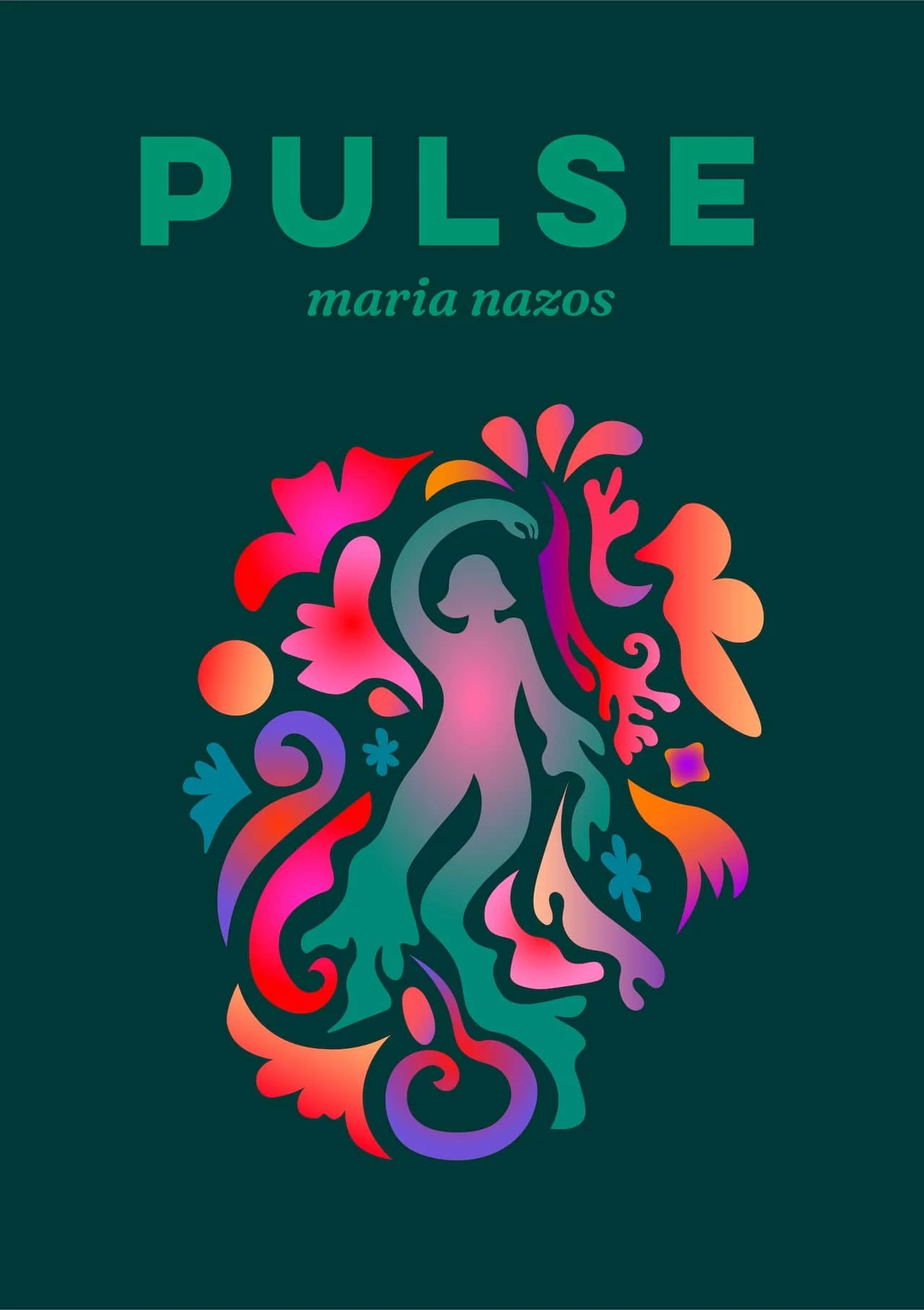
Click on the front cover of the book order. Published by Omnidawn; distributed through the University of Chicago.
Extended bio
Maria Nazos was born in Joliet, Illinois, and raised in Athens, Greece. She received her B.A. cum laude from the University of Iowa, her M.F.A. in Creative Writing from Sarah Lawrence College, and her PhD in English from the University of Nebraska-Lincoln. For the following years following her M.F.A., she lived in New York City, where she held a series of different literal odd jobs: She nannied, waitressed at an East Village Russian vodka bar, adjuncted at The College of New Rochelle’s Tribeca campus, and taught poetry at The Boys’ Club in Harlem and Queens.
Over the next six years, she lived in Provincetown, Massachusetts, where she split her time writing, traveling, and obtaining fellowships and scholarships from the Fine Arts Work Center (FAWC), the Virginia Center for the Creative Arts (VCCA), the Santa Fe Art Institute, and the Vermont Studio Center. Her first collection of poems, A Hymn that Meanders, mostly written while working on the whale watch boat, was published by Wising Up Press in 2012. All the while, she continued to work a series of jobs, including as a whale-watching boat attendant, sunglasses salesperson, barista, and adjunct English professor at Cape Cod Community College.
After reviving her love of teaching, she was awarded a Chancellor’s Fellowship to the University of Nebraska-Lincoln’s (UNL) English PhD program, where she taught Poetry, Creative Writing, Women’s and Gender Studies, and Great Plains Studies and served as the Graduate Assistant to former U.S. Poet Laureate Ted Kooser and American Life in Poetry, his nationally syndicated newspaper column. In between, she still managed to write and pursue global misadventures, including backpacking alone from Belize and crossing the border into Guatemala.
Her work received a Tennessee Williams Scholarship from the Sewanee Writers’ Conference, a Mayor’s Award, a Kimmel Harding Nelson Center for the Arts residency, and distinctions from the Academy of American Poets, a Louise Van Sickle Award for Poetry, a Stuff Dissertation Fellowship, and a Certificate for Contributions to Students for her teaching.
In 2013, Maria graduated magna cum laude from UNL’s English doctoral program with an emphasis on Poetry and a minor in Women’s and Gender Studies.
After earning her PhD, Maria abandoned academic pursuits to work in tech while continuing to write and publish avidly. She went on to place part of her doctoral thesis, which originated under Ted Kooser’s supervision: A collection of translations from the Greek poet, Dimitra Kotoula, entitled The Slow Horizon that Breathes (World Poetry Books, 2023). It was longlisted for the Angelo-Hellenic League Runciman Award, with a foreword by A.E. Stallings. Maria also chaired the AWP panel, “On Speaking Terms: How to Forge Health Translator-Writer Relationships,” with Aliki Barnstone and Jim Kates.
Her poetry, translations, and essays have been widely published in hundreds of journals, magazines, including The New Yorker, The Mid-American Review, The Columbia Review, the Poetry Foundation, The North American Review, and The Birmingham Poetry Review, and anthologies, including What Saves Us: Poems of Empathy and Outrage in the Age of Trump, edited by Martín Espada, (Northwestern University Press, 2020), and Nasty Women, An Unapologetic Anthology of Subversive Verse, edited hy Julie Kane and Grace Bauer (Lost Horse Press, 2016). Kaveh Akbar recognized her work as one of the winners of the Palette Poetry Love & Eros Contest.
Maria’s collection of poems, PULSE, is forthcoming from Omnidawn in 2026. PULSE has already received a good bit of early positive critical reception.
Kate Gale, Founding Editor of Red Hen Press, said, “PULSE refuses to sorrow deep and instead blooms and plunges into wonder up where the air grows thin.”
David Koehn remarked, “Like a disco ball above a war zone, PULSE pulses with why poetry matters, with grit and glitter. These poems remember what it’s like to be wild and breakable, to be held and to vanish, to run toward danger just to feel the wind.”
And Joy Castro, author of Flight, said, “Luscious psalms to divine recklessness, the poems in Maria Nazos's PULSE wear their formal brilliance lightly…A marvel.”
After her many tumultuous careers as a whale-watching boat attendant, a table dancer, and, arguably, the worst waitress on the Eastern Seaboard, she has settled into a quieter life as a digital content developer in Lincoln, Nebraska, accompanied by two quirky cats and a patient husband. If she spilled Pinot Noir on you, she sincerely apologizes.